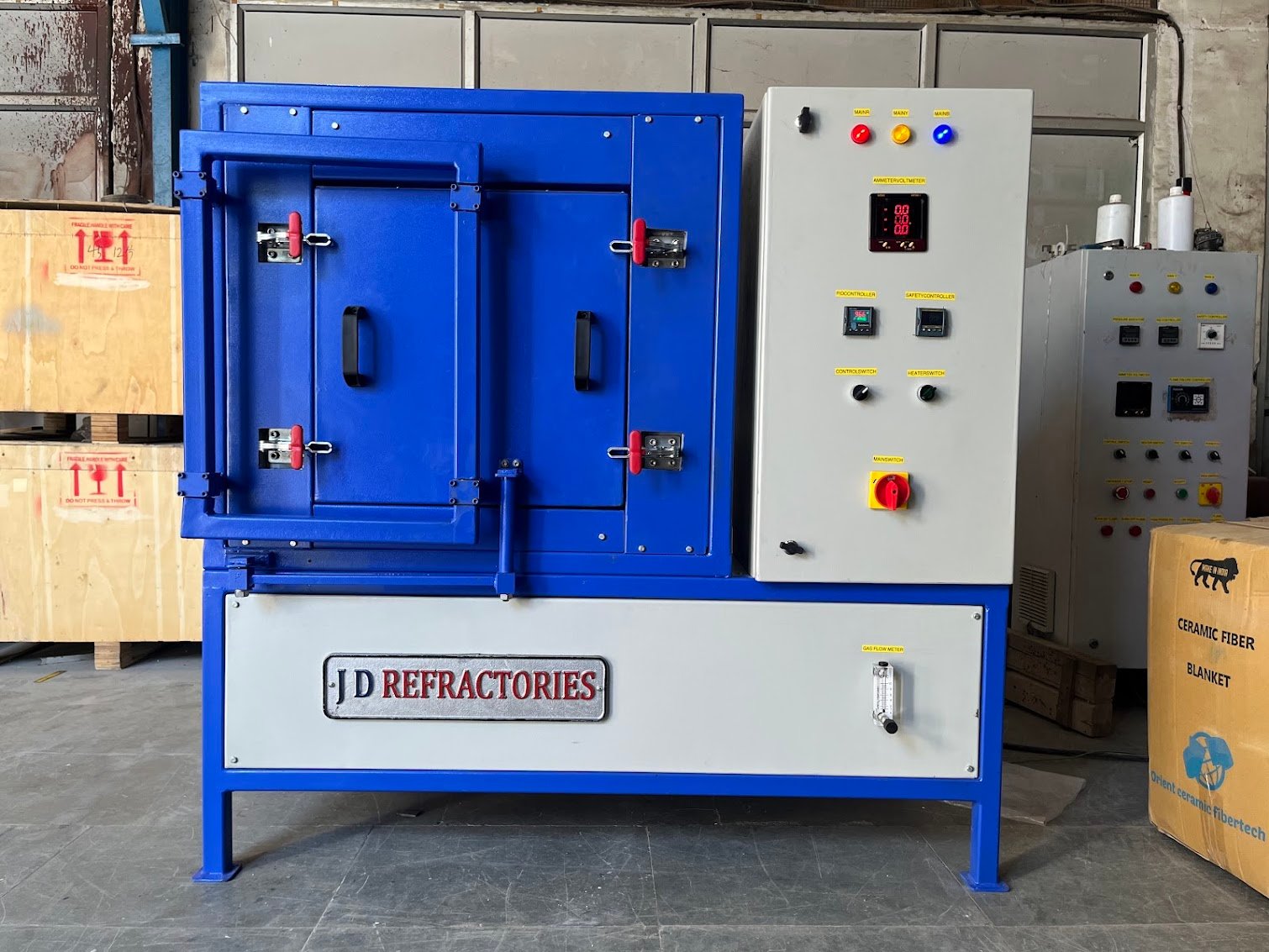
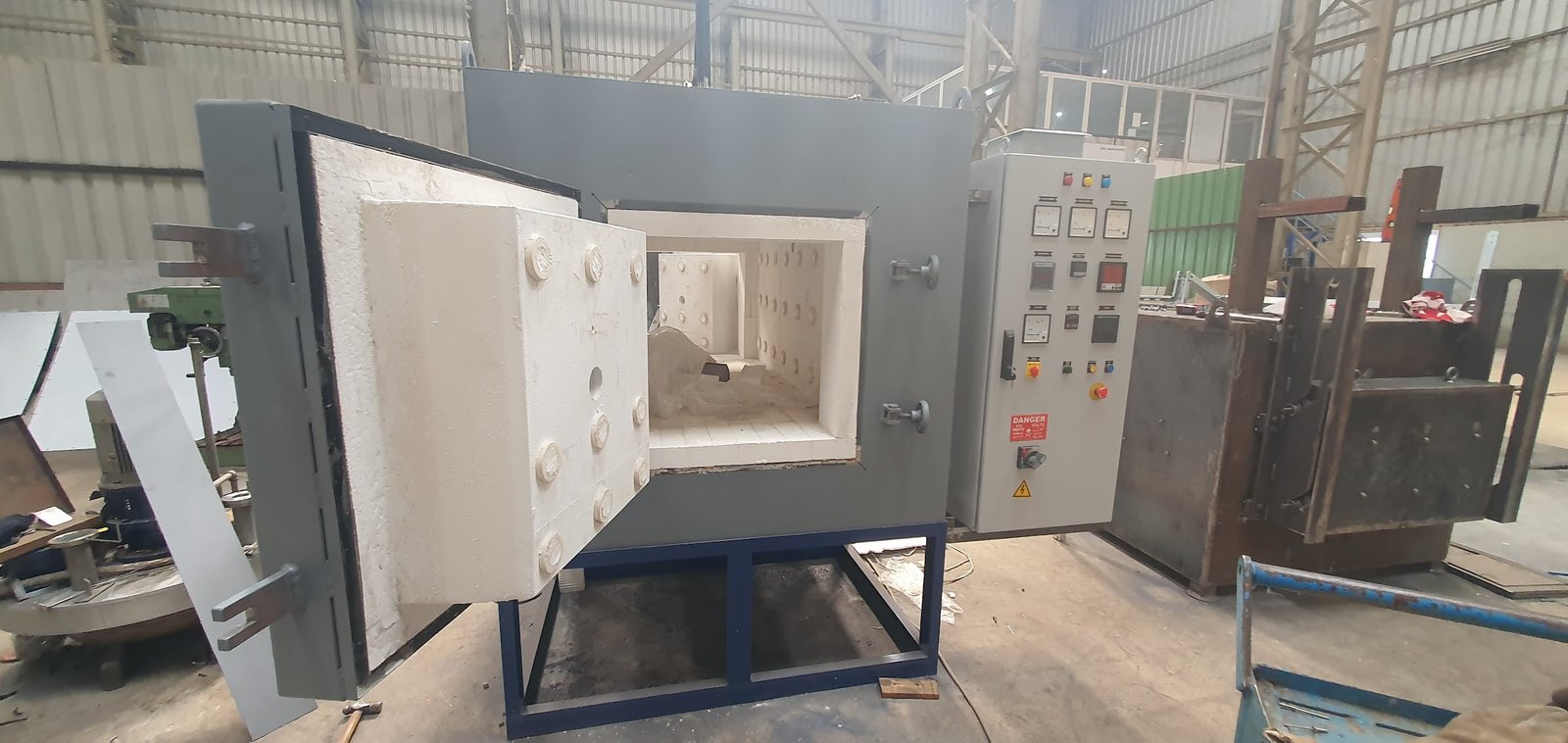
Chamber Batch Furnace
chamber furnace can operate up to 1800°C. These furnaces are usually rugged, refractory based construction or lightweight ceramic fiberboard and insulation based in construction. Heating elements could be Ferrous-Alumel-Chromel alloys, nichrome, silicon carbide or molybdenum disilicide depending on the temperature and process; and could be in the form of single or bundled wires, rods, wound coils, strips. Chamber and box furnaces are the workhorses of thermal processing, operating at temperatures up to 1800°C for critical applications like hardening, annealing, sintering, and stress-relieving. Because these batch systems experience rapid heating cycles and frequent door openings, their thermal linings demand exceptional thermal shock resistance, low heat storage, and uncompromising structural integrity. At J D Refractories, we engineer complete, high-efficiency refractory lining packages tailored to the unique mechanical and thermal profiles of industrial chamber furnaces.
Our Chamber and Box Furnaces are the definitive choice for
heavy-duty, versatile batch thermal processing. Engineered to operate at
temperatures ranging from 550°C to 1800°C, these rugged thermal
enclosures are designed for applications requiring precise temperature
uniformity, robust structural longevity, and flexible cycle management.
Unlike continuous systems, our chamber furnaces process
workloads in distinct batches—making them ideal for low-to-medium volumes,
varied cycle profiles, and custom-sized components. Whether you are performing
standard metallurgical heat treatment or specialized high-temperature
sintering, our systems deliver the reliability your production line demands.
Key Features & Technical Specifications
Standard Features
- Heavy-Duty
Construction: Built with a reinforced structural steel outer casing to
ensure long-term durability and eliminate structural warping under
continuous heat.
- Advanced
Multi-Zone Heating: Strategically positioned heating elements ensure
balanced radiant heat and excellent temperature uniformity across the
entire workspace.
- Precision
Control Systems: Equipped with digital PID micro-processors,
programmable multi-segment ramp/soak profiles, and high-visibility digital
displays.
- Comprehensive
Insulation: Double-walled casing configuration paired with multi-layer
high-grade insulation minimizes cold-face casing temperatures and
maximizes energy efficiency.
Technical Specifications
|
Parameters |
Standard Range Details |
Custom Specifications |
|
Temperature Range |
1000°C to 1400°C |
Up to 1800°C |
|
Heating Source |
Electric / Gas-Fired |
Custom Dual-Fuel options available |
|
Heating Elements |
Nichrome / Kanthal Alloys, SiC |
Molybdenum Disilicate (MoSi 2) |
|
Atmosphere Support |
Ambient Air |
Inert Gas Purging (Nitrogen, Argon) |
|
Control Accuracy |
+/- 5°C |
High-precision specialized tuning |
|
Door Operation |
Vertical Lift / Swing Out |
Pneumatic / Hydraulic automation |
Applications
Our chamber furnaces are highly adaptable and cater to
critical thermal processing profiles across multiple sectors:
Heat Treatment Applications
- Hardening
& Tempering: Maximizing mechanical strength, durability, and
toughness.
- Annealing
& Normalizing: Stress-relieving structural components and refining
grain structures (available under protective atmospheres).
- Isothermal
& Decarb Annealing: Tailored for complex alloy treatments.
- Post
Weld Heat Treatment (PWHT): Relieving residual stresses in heavy
welded assemblies.
- Thermochemical
Cases: Carburizing, Case Hardening, Carbonitriding, and Ferritic Nitro
Carburizing.
- Advanced
Metallurgy: Blueing, Austempering, Bainitic Hardening, Austenitizing,
and Martempering.
Aluminium Processing Applications
- Solution
Annealing / Solutionizing
- Homogenizing
- Billet
Heating
- Die
Heating
Powder Metallurgy & Sintering
- Debinding
/ Delubing / Dewaxing
- Pre-Sintering
and High-Temperature Sintering of advanced ceramics and metals.
Specialized Engineering Applications
- High-temperature
Brazing & Carbonization
- Mould
/ Core Preheating
- Laboratory
& R&D Pilot Plant testing
Why Choose Us?
The answer is simple: We are the industry benchmark when
it comes to custom-engineered industrial furnaces and exceptional thermal
efficiency. Customer satisfaction is our absolute priority.
- Continuous
Innovation: Our equipment leverages state-of-the-art heating
technology and structural engineering, giving you an edge in both process
consistency and running costs.
- Global
Footprint, Trusted Quality: We have built an impressive global
clientele that relies on our systems year after year for their most
critical manufacturing workflows.
- A
Vehicle for Your Success: When you partner with us, you are not just
purchasing a machine—you are securing a reliable, highly efficient asset
backed by end-to-end technical support. No matter the scale or sector of
your company, when you work with us, you can rest assured.
Frequently Asked Questions (FAQs)
What is a Batch/Chamber Furnace?
A batch or a chamber furnace is a batch-type thermal
processing system where materials are loaded directly onto the hearth or into a
fixture/basket for a single heating and cooling cycle. It offers the
flexibility to process varying batch weights, shapes, and heat profiles that
continuous furnaces cannot accommodate.
What heating elements are used in your chamber furnaces?
Depending on your maximum operating temperature, we utilize
premium resistive wire alloys (for up to 1200°C), Silicon Carbide (SiC)
rods (for up to 1450°C), or Molybdenum Disilicate (MoSi2) heating
elements for high-temperature applications reaching up to 1800°C.
Can the furnace be used with an inert or reducing
atmosphere?
Yes. Our furnaces can be designed with gas-tight casings,
integrated gas purging manifolds, and flow meters to safely manage processing
under protective atmospheres like nitrogen, argon, or forming gas.
How is temperature uniformity maintained?
We achieve precise temperature uniformity by utilizing
precise heating element distribution patterns and advanced multi-zone PID
controllers. For lower temperature ranges, high-velocity air-circulation fans
are integrated to distribute heat evenly.
What types of instrumentation and safety controls are
provided?
Every furnace features a state-of-the-art control panel
equipped with PLC automation, user-friendly HMIs, data loggers for audit
compliance, and multi-tier safety interlocks (such as over-temperature
protection limits and automatic heating cut-offs upon door opening).